
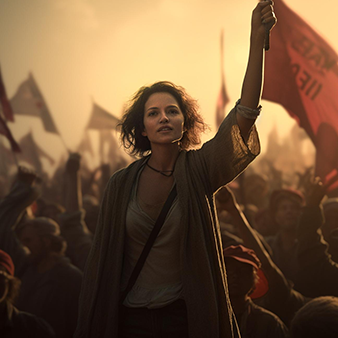
Breaking Free from Cultural Norms: A Woman’s Fight for Independence in Hope’s Journey
What does it take to break free from expectations that were placed on you before you were old enough to understand them?
In Hope’s Journey, the answer unfolds slowly. It is not a loud rebellion or dramatic escape. It is quiet endurance, painful self-discovery, and the steady rebuilding of identity. Hope’s story is not simply about divorce or immigration. It is about challenging deeply rooted cultural norms and daring to imagine a different life.
A Childhood Shaped by Tradition
Hope grows up in a conservative environment where tradition shapes daily life. Gender roles are clear. Boys and girls are separated. Family honor matters deeply. Reputation can outweigh personal desire.
As a child, Hope dreams boldly. She imagines herself as a CEO, practicing her signature on her balcony. However, even in her fantasy, doubt slips in. “I am a girl,” she tells herself. That quiet sentence reflects the invisible boundaries surrounding her.
From an early age, Hope understands that her dreams must pass through the filter of cultural expectations. Ambition is allowed, but only within limits.
Marriage at Fourteen: Duty Over Choice
At fourteen, Hope is married to a man eighteen years older than her. Family arrangements and community norms shape the decision. Her personal readiness is not the focus. Reputation, stability, and tradition take priority.
This moment sets the foundation for one of the book’s most powerful themes: how cultural pressure can override personal agency.
Yet one critical condition becomes her lifeline. Her father insists she be allowed to continue her education. That agreement, small as it seems, becomes Hope’s anchor. School is not just about learning. It represents possibility. It reminds her that her mind still belongs to her.
A New Country, the Same Expectations
When Hope moves to the United States, many would assume she has entered a state of freedom. But Hope’s Journey challenges that idea.
Geography changes. Control does not.
Living with her in-laws, Hope faces constant criticism. She is mocked for studying. Her desire to grow intellectually is treated as foolish. She does not speak English fluently. She has no family nearby. She walks to school alone, determined not to get lost, determined not to quit.
The book makes a clear point here: freedom is not automatic. It must be claimed.
Hope’s isolation in America mirrors the restrictions she faces back home. Different setting. Same pressure.
Faith, Endurance, and Silent Sacrifice
Hope was raised to believe that respecting elders is sacred. She is taught that upsetting parents invites divine punishment. She internalizes the idea that endurance is virtuous.
Therefore, she endures.
She tolerates emotional neglect. She tolerates criticism. She swallows her voice to maintain peace. For years, she has believed this is a strength.
Nevertheless, endurance has limits.
Through raising her children, especially her son, who faces developmental challenges, Hope begins to rediscover her inner resilience. When professionals doubt her son’s future, she refuses to accept it. She pours everything into helping him grow. Years later, he becomes a doctor.
That transformation mirrors her own. Just as she refuses to let others define her son, she slowly refuses to let others define her.
The Turning Point: Choosing Dignity
The breaking point does not arrive in one dramatic moment. It builds over time.
Hope realizes she is disappearing inside her marriage. Her dreams are shrinking. Her identity is fading. The cultural script says stay. Be patient. Endure.
But she begins to question: At what cost?
When she finally asks for a divorce, the backlash is swift. Family members turn against her. Influential community figures side with her husband. Even a respected religious authority supports him.
The message is clear. A woman who leaves disrupts the system.
Here, the book boldly confronts societal double standards. Men are granted freedom to make mistakes. Women are expected to preserve appearances.
Hope chooses dignity anyway.
The Cost of Breaking Free
Hope’s Journey does not romanticize independence. Breaking free is expensive. Hope faces financial instability. She fears losing custody of her children. She experiences deep loneliness.
Independence is not glamorous. It is exhausting.
She works multiple jobs. She pursues higher education. She fights legal battles. She buys a home so her children have stability. She sacrifices comfort for long-term security.
Even later, when her children grow closer to their father, she accepts it as part of the price she paid for their future.
This emotional maturity sets the book apart. Independence is not revenge. It is a responsibility.
Redefining Culture Without Rejecting It
One of the most compelling aspects of Hope’s Journey is that Hope does not reject her culture entirely. She carries her faith. She values family. She honors education. She respects tradition where it uplifts.
What she rejects are the parts that demand her silence.
The book challenges readers to separate culture from control. It asks difficult questions:
- When does tradition protect people, and when does it protect reputation?
- When does obedience become self-erasure?
- Who benefits when women stay quiet?
Hope’s story suggests that true strength lies in discernment. Keeping what nourishes. Releasing what suffocates.
A Legacy of Choice
By the end of her journey, Hope is no longer defined by early marriage, divorce, or hardship. She becomes an educator. A professional. A woman who rebuilt her life gradually.
Her fight for independence is not just personal. It is generational. Her children grow up watching her choose courage over comfort. That lesson may shape them more than anything else may.
Hope’s Journey ultimately delivers a powerful message: cultural norms are not destiny. They are frameworks. And frameworks can be questioned.
Hope’s life invites readers, especially women navigating similar pressures, to examine their own invisible boundaries. Which expectations uplift you? Which ones shrink you? In addition, what would change if you dared to choose differently?
Breaking free does not mean abandoning identity. It means reclaiming it.
Hope did not escape culture. She reshaped her relationship with it.
And in doing so, she turned survival into independence, and independence into legacy.